

Health Library
Craniopharyngioma
Adamantinomatous craniopharyngioma; Ordinary craniopharyngioma; Papillary craniopharyngioma; Rathke pouch tumor; Hypophyseal duct tumor; Adamantinoma
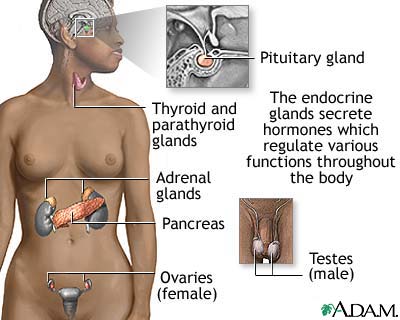
A craniopharyngioma is usually a noncancerous (benign) tumor that develops at the base of the brain near the pituitary gland.
Images
I Would Like to Learn About:
Causes
The exact cause of the tumor is unknown.
This tumor most commonly affects children from 5 to 14 years of age. Adults 50 to 74 years can sometimes be affected. Boys and girls are equally likely to develop this tumor.
Symptoms
A craniopharyngioma causes symptoms by:
- Increasing pressure on the brain, usually from hydrocephalus
- Disrupting hormone production by the hypothalamus or pituitary gland
- Pressure or damage to the optic nerve
Increased pressure on the brain can cause:
- Headache
- Nausea
- Vomiting (especially in the morning)
- Change in appetite and weight
- Confusion and drowsiness
Damage to the pituitary gland causes hormone imbalances that can lead to excessive thirst and urination, and slow growth.
When the optic nerve is damaged by the tumor, vision problems develop. These defects are often permanent. They may get worse after surgery to remove the tumor.
Behavioral and learning problems may be present.
Exams and Tests
Your health care provider will perform a physical exam. Tests will be done to check for a tumor. These may include:
- Blood tests to measure hormone levels
- A CT scan and MRI scan of the brain
- An examination of the nervous system
- Testing your vision
Treatment
The goal of the treatment is to relieve symptoms. This tumor is best treated at a center with experience in treating craniopharyngiomas.
Usually, surgery has been the main treatment for craniopharyngioma. However, radiation treatment instead of surgery or along with a smaller surgery may be the best choice for some people.
In tumors that cannot be removed completely with surgery alone, radiation therapy is used. If the tumor has a classic appearance on a CT scan, a biopsy may not be needed if treatment with radiation alone is planned. In some people, a shunt may be placed to treat the hydrocephalus.
Stereotactic radiosurgery is performed at some medical centers.
Hormonal replacement, short-term or long-term, might be needed.
Outlook (Prognosis)
In general, the outlook is good. There is an 80% to 90% chance of a cure at 10 years if the tumor can be completely removed with surgery or treated with high doses of radiation. If the tumor returns, it will most often come back within the first 2 years after surgery. Follow-up includes yearly MRIs and hormonal testing.
The outlook depends on several factors, including:
- Whether the tumor can be completely removed
- Which nervous system problems and hormonal imbalances the tumor and treatment cause
Most of the problems with hormones and vision do not improve with treatment. Sometimes, the treatment may even make them worse.
Possible Complications
There may be long-term hormone, vision, and nervous system problems after craniopharyngioma is treated. The hormonal complications include diabetes insipidus, which causes excessive thirst and urination. This can be temporary or permanent.
When the tumor is not completely removed, it may return and cause additional symptoms.
Other complications include:
- Hypothalamic obesity and metabolic issues
- Cognitive and behavioral changes
- Seizures
- Vascular complications such as stroke
When to Contact a Medical Professional
Contact your provider for the following symptoms:
- Headache, confusion, drowsiness, nausea, vomiting, or balance problems (signs of increased pressure on the brain)
- Failing to keep up in school
- Weight loss or gain
- Increased thirst and urination
- Poor growth in a child
- Vision changes
Related Information
TumorEndocrine glands
References
Kayadjanian N, Hsu EA. Treatment priorities in craniopharyngioma: Perspectives of survivors and caregivers. Biomedicines. 2026;14(3):664. PMID: 41898310 pubmed.ncbi.nlm.nih.gov/41898310/.
Pitteloud N, Papadakis GE, Jacobs AN. Physiology and disorders of puberty. In: Melmed S, Auchus RJ, Goldfine AB, Rosen CJ, Kopp PA, eds. Williams Textbook of Endocrinology. 15th ed. Philadelphia, PA: Elsevier; 2025:chap 23.
Suh JH, Chao ST, Murphy ES, Kshettry VR, Recinos PF. Pituitary tumors and craniopharyngiomas. In: Foote RL, Michalski JM, Viswanathan AN, Tepper JE, eds. Gunderson & Tepper's Clinical Radiation Oncology. 6th ed. Philadelphia, PA: Elsevier; 2026:chap 36.
Zaky W. Central nervous system tumors in childhood. In: Kliegman RM, St. Geme JW, Blum NJ, et al, eds. Nelson Textbook of Pediatrics. 22nd ed. Philadelphia, PA: Elsevier; 2025:chap 546.
BACK TO TOPReview Date: 4/13/2026
Reviewed By: Luc Jasmin, MD, Ph.D., FRCS (C), FACS, Department of Neuroscience, Guam Regional Medical City, Guam; Department of Surgery, Johnson City Medical Center, TN; Department of Maxillofacial Surgery at UCSF, San Francisco, CA. Review provided by VeriMed Healthcare Network. Also reviewed by David C. Dugdale, MD, Medical Director, Brenda Conaway, Editorial Director, and the A.D.A.M. Editorial team.
 | A.D.A.M., Inc. is accredited by URAC, for Health Content Provider (www.urac.org). URAC's accreditation program is an independent audit to verify that A.D.A.M. follows rigorous standards of quality and accountability. A.D.A.M. is among the first to achieve this important distinction for online health information and services. Learn more about A.D.A.M.'s editorial policy, editorial process and privacy policy. A.D.A.M. is also a founding member of Hi-Ethics. This site complies with the HONcode standard for trustworthy health information: verify here. |
The information provided herein should not be used during any medical emergency or for the diagnosis or treatment of any medical condition. A licensed medical professional should be consulted for diagnosis and treatment of any and all medical conditions. Links to other sites are provided for information only -- they do not constitute endorsements of those other sites. No warranty of any kind, either expressed or implied, is made as to the accuracy, reliability, timeliness, or correctness of any translations made by a third-party service of the information provided herein into any other language.
© 1997-
2026 A.D.A.M., a business unit of Ebix, Inc. Any duplication or distribution of the information contained herein is strictly prohibited.
All content on this site including text, images, graphics, audio, video, data, metadata, and compilations is protected by copyright and other intellectual property laws. You may view the content for personal, noncommercial use. Any other use requires prior written consent from Ebix. You may not copy, reproduce, distribute, transmit, display, publish, reverse-engineer, adapt, modify, store beyond ordinary browser caching, index, mine, scrape, or create derivative works from this content. You may not use automated tools to access or extract content, including to create embeddings, vectors, datasets, or indexes for retrieval systems. Use of any content for training, fine-tuning, calibrating, testing, evaluating, or improving AI systems of any kind is prohibited without express written consent. This includes large language models, machine learning models, neural networks, generative systems, retrieval-augmented systems, and any software that ingests content to produce outputs. Any unauthorized use of the content including AI-related use is a violation of our rights and may result in legal action, damages, and statutory penalties to the fullest extent permitted by law. Ebix reserves the right to enforce its rights through legal, technological, and contractual measures.
